Stone Repair in Ames, IA | 10+ Years Experience
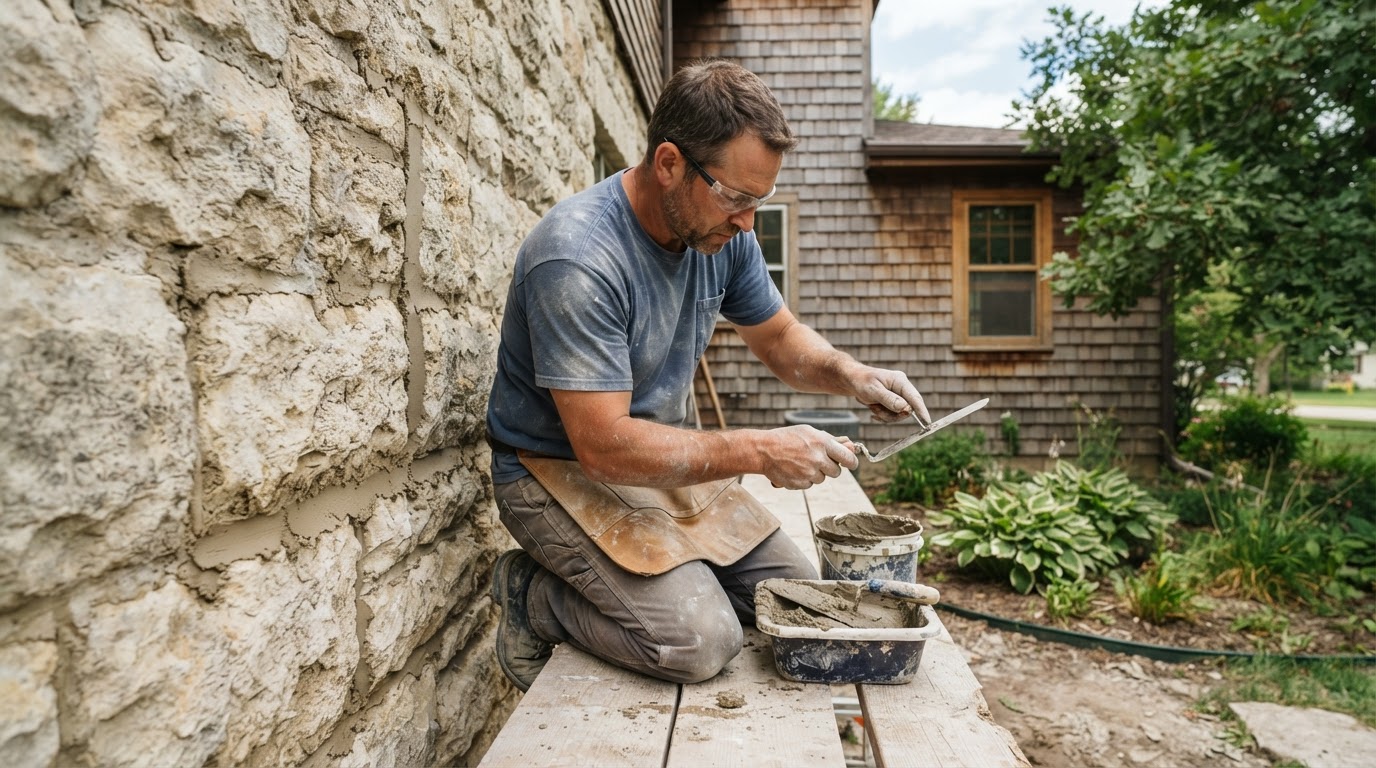
Ames Masonry Pro repairs loose, cracked, displaced, and deteriorated natural stone and manufactured stone veneer for residential and commercial properties across Ames, Nevada, Huxley, and Story City. Whether a limestone accent has loosened, fieldstone joints have failed, or manufactured stone veneer is pulling away from the wall, the repair evaluates the stone type, mortar, movement, and substrate or attachment conditions before resetting, replacing, or repointing the affected area.
With 10+ years of hands-on masonry experience and insured service, every stone repair distinguishes natural stone masonry from manufactured veneer — because the two are repaired differently — and uses compatible mortar and matching material so the repair respects the existing stonework. Central Iowa freeze-thaw exposure, moisture, and movement drive much of the stone deterioration here, and the repair addresses those causes rather than just patching the visible damage. No invisible repair or exact stone duplication is promised when matching material is unavailable.
Request an Estimate
Tell us about your project. We respond to estimate requests for Ames, Nevada, Huxley, Story City, Iowa.
Why Choose Ames Masonry Pro for Stone Repair in Ames?
10+ Years of Masonry Experience
More than a decade of stone masonry work informs how each wall is evaluated — reading whether loose stone is from failed mortar, movement, substrate attachment, or moisture, and distinguishing natural stone from manufactured veneer. That experience means the repair uses the right approach for the specific stone type and assembly.
Insured Service
Ames Masonry Pro is insured, giving property owners protection while stone repair work is underway on their home or commercial building. Insurance is part of doing the job responsibly across all stone repair scopes.
Natural and Manufactured Stone Awareness
Natural stone masonry and manufactured stone veneer are repaired differently — natural stone is reset or repointed as full-depth masonry, while veneer repair addresses the thin units and their attachment to the substrate. Knowing the difference ensures the repair matches the assembly rather than treating veneer as full-depth stone.
Mortar and Material Compatibility
Replacement mortar is matched to the existing joints for color, composition, and hardness, and replacement stone is selected to blend with the existing material. Compatible materials ensure the repair performs correctly with the surrounding stonework and blends visually, within the limits of available matching material.
Cause-First Repair and Selective Replacement
Before any stone is reset or replaced, the cause — failed mortar, water entry, movement, or substrate condition — is evaluated so the repair addresses the source. Selective replacement preserves sound stone rather than replacing an entire wall when only a few units have failed.
Moisture and Detail Awareness with Transparent Scope
Moisture entry, flashing, and drainage details are evaluated as part of the repair, because water drives much of the deterioration. The scope is explained clearly — what will be reset, replaced, or repointed, and why — with honest pricing context tied to the specific stone and condition.
Our Stone Masonry Repair Services
Loose or Displaced Stone Repair
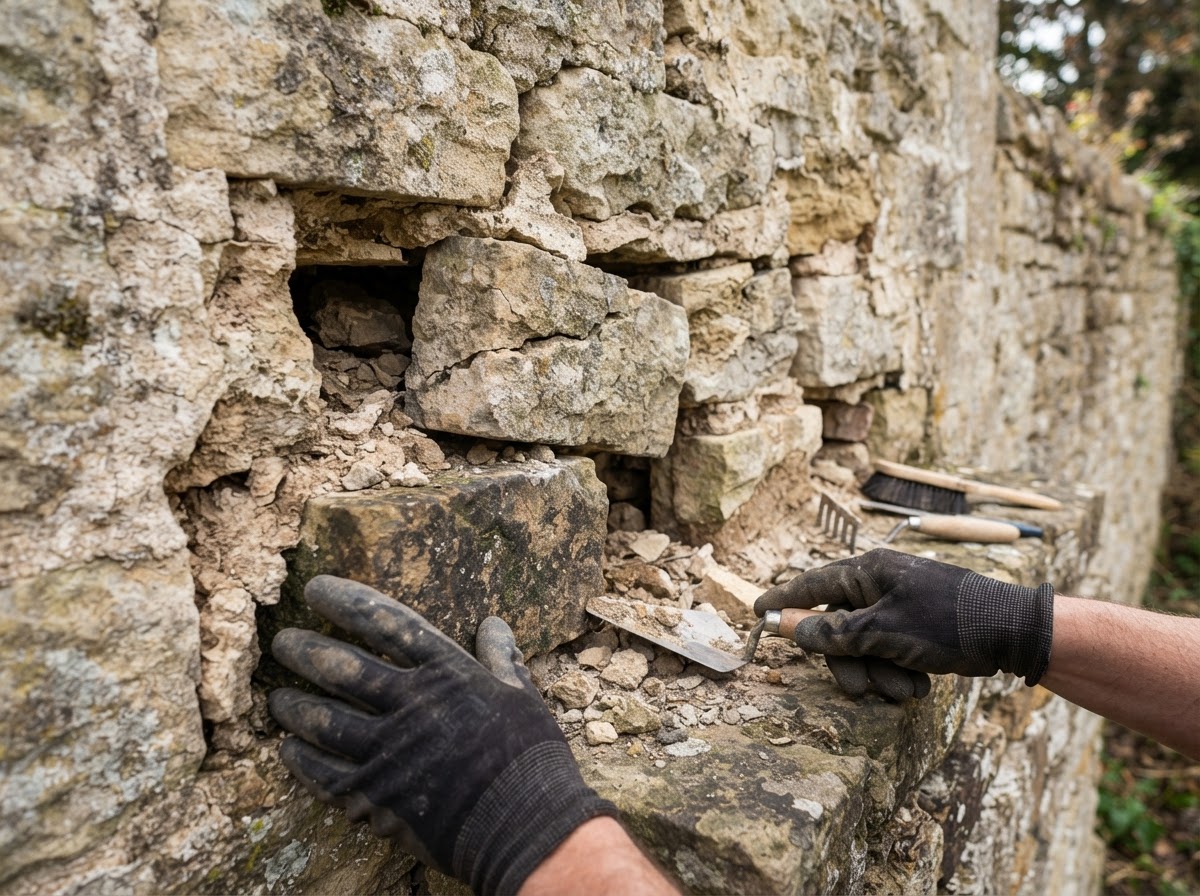
Loose or displaced stone repair resets natural stone units that have shifted, rotated, or pulled out of plane on Ames walls, foundations, and accents. It suits limestone, fieldstone, and other natural stone masonry where mortar has failed or movement has loosened individual units.
The loose stone is carefully removed, the cavity is cleaned, and the stone is reset in compatible mortar matched to the existing joints with proper joint profile and tooling. The movement or moisture cause that loosened the stone is evaluated so the reset unit stays secure.
Owners regain a stable, plumb stone wall with units firmly set in sound mortar, eliminating the safety and water-entry hazards that loose stone creates.
Cracked or Damaged Stone Replacement
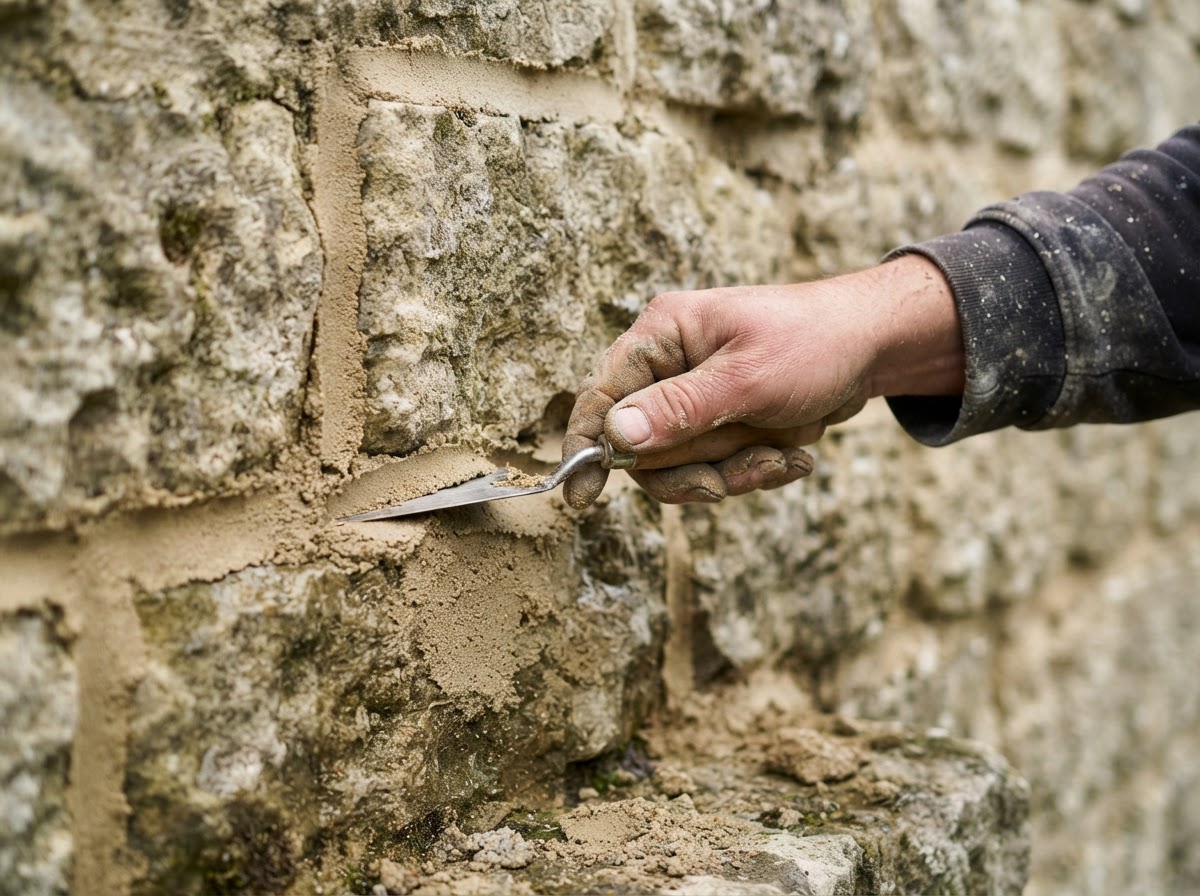
Cracked or damaged stone replacement replaces natural stone units that have cracked, spalled, or deteriorated beyond repair on Ames properties. It suits walls where specific stones have failed but the surrounding masonry is sound and does not need full replacement.
The damaged stone is removed cleanly, a compatible replacement unit is selected to blend with the existing material in color and texture, and the new stone is set in matched mortar with proper joint tooling. Matching is close within available material, not an exact invisible duplication.
Owners restore the wall's appearance and integrity without full replacement, preserving the sound stone and replacing only what has failed.
Mortar Joint Repair and Repointing
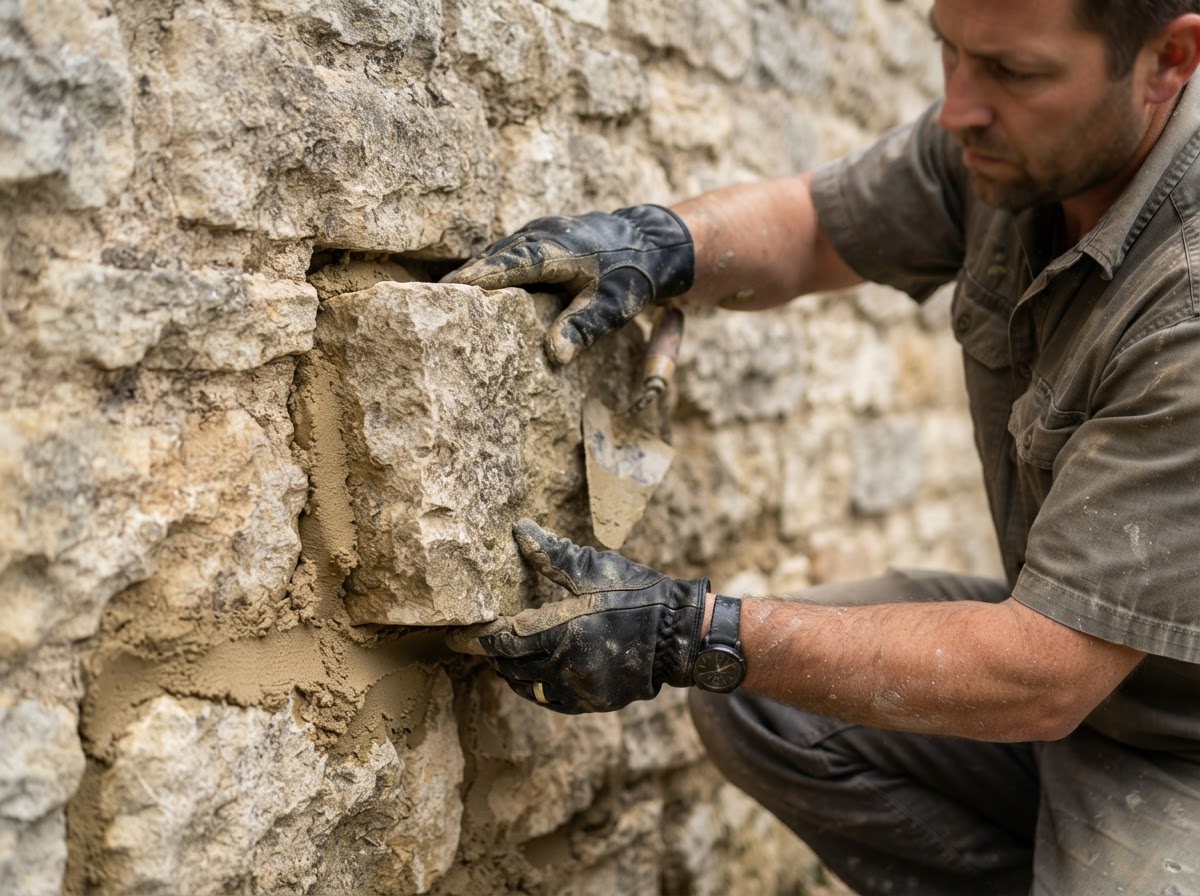
Mortar joint repair and repointing renews the failed, eroded, or cracked mortar joints between natural stone units on Ames walls and foundations. It suits stonework where the units are sound but the joints have deteriorated and are admitting moisture.
Failed mortar is raked out to proper depth, the joints are cleaned, and compatible replacement mortar matched to the existing color and composition is pressed in and tooled to the original joint profile, so the joints blend and shed water correctly.
Owners get a weathertight stone wall with restored joint integrity that protects the stone from the freeze-thaw damage and water intrusion that failed joints allow.
Stone Veneer Repair
Stone veneer repair addresses manufactured stone veneer that has loosened, cracked, or pulled away from the substrate on Ames home exteriors and accents. It suits adhered veneer assemblies where individual pieces have lost bond or the scratch coat and lath beneath have failed.
The veneer assembly is evaluated — the loose pieces are removed, the substrate, lath, and scratch coat are inspected and corrected where needed, and the veneer pieces are reinstalled with compatible mortar and proper adhesion. Veneer repair is not treated as identical to full-depth natural stone masonry, because the assembly is different.
Owners get veneer that is securely bonded to a sound substrate, with the drainage and attachment details that prevent the pieces from loosening again.
What Causes Stone Masonry to Need Repair?
Failed Mortar Joints
Mortar joints between stone units erode, crack, or recede over time from weather exposure, allowing water to penetrate and loosening the stones. Failed joints are the most common cause of loose and displaced natural stone, and repointing restores the bond before the stones shift.
Water Entry and Freeze-Thaw Exposure
Water entering through failed joints or cracks saturates the stone and mortar, then freezes and expands — causing spalling, cracking, and joint deterioration. Central Iowa freeze-thaw cycles make water entry a primary driver of stone masonry damage.
Movement or Substrate Conditions
Wall movement from settlement or thermal stress cracks stone and joints, and for veneer, substrate or attachment failure — deteriorated lath, failed scratch coat, or moisture behind the veneer — causes pieces to loosen and pull away. Movement and substrate conditions require evaluation to define the correct repair.
Impact, Age, or Previous Incompatible Repairs
Impact damage, long-term aging, and prior repairs with incompatible mortar or incorrect methods can all damage stone masonry. Hard mortar in soft stone joints concentrates stress and causes new cracking, and incompatible repairs often create the mixed conditions that later repair must resolve.
What Are the Signs Stone Masonry Needs Repair?
Loose or Moving Stone
Stone that has shifted, rotates when touched, or is visibly out of plane has lost its mortar bond or is affected by movement. Loose stone is a safety and water-entry hazard that should be reset promptly, with the cause evaluated before repair.
Cracked or Missing Mortar
Mortar joints between stone units that are cracked, eroded, recessed, or missing are no longer bonding the stones or keeping water out. Failed joints should be repointed before water intrusion and freeze-thaw damage spread to the stone units themselves.
Surface Deterioration or Persistent Staining
Stone faces that are spalling, flaking, or showing persistent efflorescence and staining indicate moisture is moving through the masonry and damaging the stone. Surface deterioration is a sign that the water source needs to be found and addressed alongside the repair.
Gaps at Corners, Openings, or Material Transitions
Gaps where stone meets corners, openings, or other materials indicate movement, failed sealant, or attachment failure. These gaps are water-entry paths that should be evaluated to determine whether the repair involves the stone, the sealant, or the substrate behind it.
How Does Stone Repair Work?
Step 1: Identify Stone and Assembly Type
The stone type — natural limestone, fieldstone, or manufactured veneer — and the assembly — full-depth masonry or adhered veneer — are identified, because each is repaired differently. This determines whether the repair involves resetting full-depth stone, repointing joints, or reattaching veneer to a substrate.
Step 2: Determine Why the Area Failed
The cause — failed mortar, water entry, movement, substrate or attachment failure, or incompatible prior repair — is evaluated so the repair addresses the source. Different causes call for different repairs, and diagnosing the failure mechanism prevents the damage from recurring.
Step 3: Select Compatible Replacement/Repair Materials
Replacement stone is selected to blend with the existing material in color and texture within available matching material, and mortar is matched to the existing joints for composition, color, and hardness. Compatible materials ensure the repair performs and blends with the surrounding stonework.
Step 4: Reset, Replace, or Repoint the Affected Area
The repair is completed according to the diagnosed cause and assembly type — resetting loose stone, replacing damaged units, repointing failed joints, or reattaching veneer to a corrected substrate. Each method uses the right approach for the specific stone and assembly.
Step 5: Finish Joints and Review Water-Entry Details
Joints are tooled to the correct profile, the repaired area is cleaned, and the water-entry details — flashing, sealant, drainage — that contributed to the failure are reviewed and addressed where within scope. The finished repair is sound and the cause is documented for the owner.
How Much Does Stone Repair Cost in Ames?
Stone repair pricing depends on whether the stone is natural or manufactured, the quantity of damaged material, mortar work, access, and substrate condition. If significant repointing is required, the locked benchmark applies to that portion. An estimate gives a number tied to your specific project.
Stone Repair Pricing Basis
Natural stone repair: priced by quantity, material, and scope
Cost depends on natural vs manufactured stone, availability and matching, quantity of damaged units, mortar work, access, wall height, substrate condition, removal and resetting, and flashing, sealant, or drainage details. An on-site estimate is needed for exact pricing.
Manufactured stone veneer repair: priced by scope and substrate
Veneer repair cost depends on the number of loose or damaged pieces, substrate and lath or scratch coat condition, access, and whether moisture behind the veneer needs to be addressed. Substrate correction significantly affects the scope.
Cost Drivers
Material matching and availability
Natural stone matching to existing material affects both cost and feasibility — some stone types are harder to source than others. Manufactured veneer pieces may be discontinued, requiring a close match rather than an exact one.
Repointing and access
If significant repointing is required, that portion runs about $7.86–$11.24 per square foot as a separate planning reference, not as stone replacement pricing. Access, wall height, and project size move the total, and an on-site estimate is needed for exact pricing.
Stone repair itself typically does not require a permit, but if the work is part of a structural wall repair, permit requirements may apply. Verify project-specific requirements with the City of Ames where relevant.
Get Your Estimate
Tell us about your project. We respond to estimate requests for Ames, Nevada, Huxley, Story City, Iowa.
Frequently Asked Questions About Stone Repair
How much does stone repair cost in Ames?
Stone repair cost depends on whether the stone is natural or manufactured, availability and matching, quantity of damaged units, mortar work, access, wall height, and substrate condition. If significant repointing is required, that portion runs about $7.86–$11.24 per square foot as a separate reference. An on-site estimate is needed for exact pricing.
Can loose stone be reset?
Yes, loose natural stone can usually be reset when the stone itself is sound and the surrounding masonry is stable. The loose stone is carefully removed, the cavity is cleaned, and the stone is reset in compatible mortar matched to the existing joints, with the cause of loosening evaluated so the reset stays secure.
Can cracked stone be replaced individually?
Yes, cracked or damaged stone can often be replaced individually when the surrounding masonry is sound. The damaged stone is removed cleanly, a compatible replacement unit is selected to blend with the existing material, and the new stone is set in matched mortar with proper joint tooling.
What causes stone mortar joints to fail?
Stone mortar joints fail from weather exposure, water entry, freeze-thaw cycling, movement, and age. Moisture entering through failed joints saturates the stone and mortar, and Central Iowa freeze-thaw cycles break the mortar down, so repointing failed joints and addressing the water source are both part of the repair.
Can new stone match older stone?
New stone can be closely matched to older stone in color and texture within available material, though an exact invisible match is not always possible because existing stone has aged and weathered. Compatible replacement units give a visually integrated repair that respects the existing stonework within the limits of what is available.
Is manufactured stone veneer repaired differently from natural stone?
Yes, manufactured stone veneer is repaired differently from natural stone, because veneer is a thin, adhered product attached to a substrate with a scratch coat and lath, while natural stone is full-depth masonry. Veneer repair addresses the thin pieces and their attachment, including the substrate and scratch coat, rather than treating the pieces as full-depth stone.
Can moisture cause stone veneer or mortar problems?
Yes, moisture behind stone veneer or in failed mortar joints is a primary cause of stone deterioration. Water entry drives freeze-thaw damage, efflorescence, and bond failure, so the moisture source is evaluated and addressed as part of the repair, or the damage will recur.
When is replacement better than a cosmetic patch?
Replacement is better than a cosmetic patch when a stone unit has cracked, spalled, or deteriorated beyond salvage, or when the cause of damage — like substrate failure or movement — means a patch will not hold. A patch over a failed unit or substrate hides rather than fixes the problem and will fail, so replacement is chosen when the unit or substrate is no longer sound.
Request Stone Repair in Ames
Call Ames Masonry Pro at 515-715-4950 for natural and manufactured stone repair in Ames, Nevada, Huxley, and Story City. 10+ years of masonry experience and insured service, with compatible materials and cause-first diagnosis.
Brick & Stone Masonry • Stone Veneer • Brick Veneer • Commercial Masonry • Masonry Restoration • FAQs
Request an Estimate
Tell us about your project. We respond to estimate requests for Ames, Nevada, Huxley, Story City, Iowa.