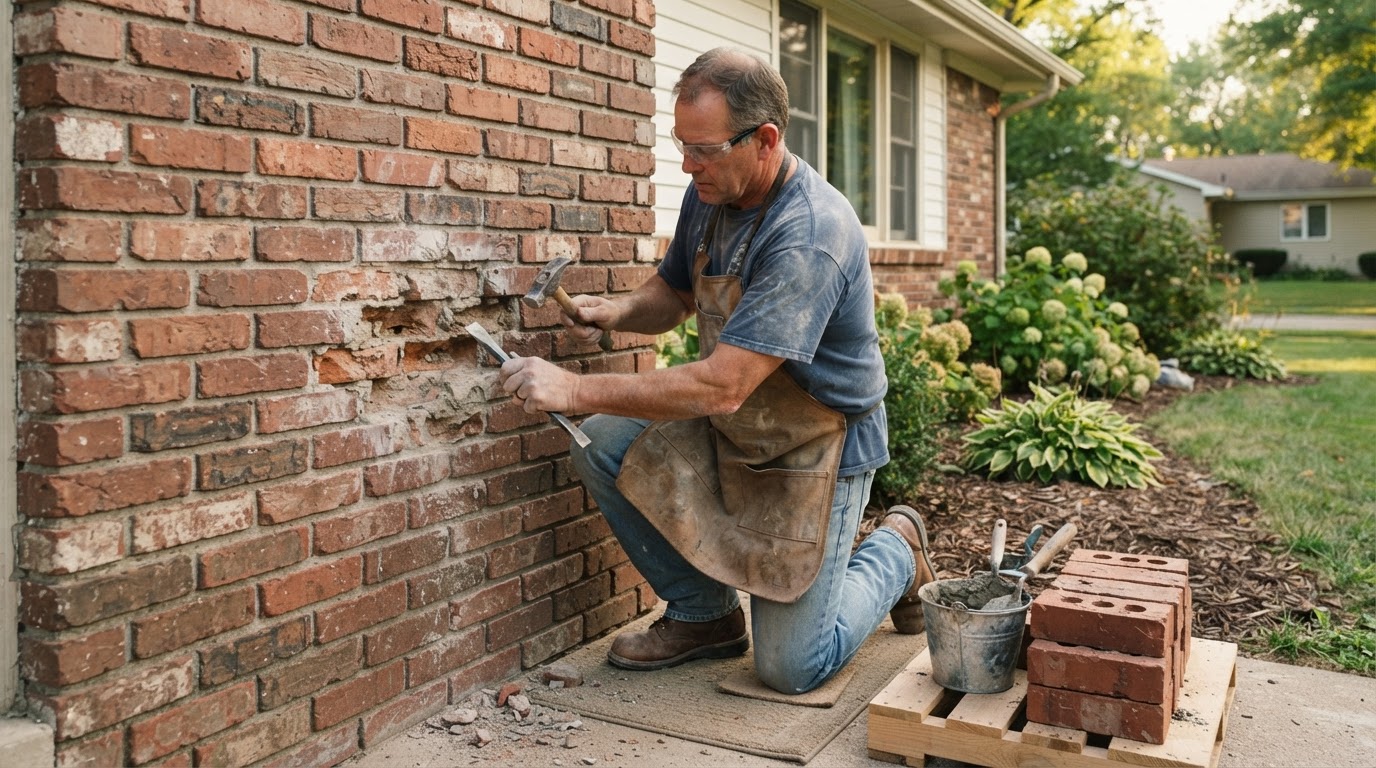
Brick Repair in Ames, IA | 10+ Years Experience
Ames Masonry Pro repairs cracked, spalled, loose, displaced, and deteriorated brick for residential and commercial properties across Ames, Nevada, Huxley, and Story City. Brick damage in Central Iowa often comes from freeze-thaw moisture cycling, water entry through failed mortar joints, movement around openings, corroding embedded components like lintels, or previous incompatible repairs — and identifying why the units failed is the first step, not just replacing the visible damage.
With 10+ years of hands-on masonry experience and insured service, every brick repair identifies the cause of failure, replaces or stabilizes the affected masonry, and uses compatible mortar and detailing appropriate to the wall. Selective brick replacement preserves sound masonry rather than rebuilding an entire wall when only a few units have failed. New brick and mortar are matched for close visual compatibility, with the understanding that existing aging and weathering can affect how perfectly a repair blends.
Request an Estimate
Tell us about your project. We respond to estimate requests for Ames, Nevada, Huxley, Story City, Iowa.
Why Choose Ames Masonry Pro for Brick Repair in Ames?
10+ Years of Masonry Experience
More than a decade of hands-on brick repair work means the cause of damage is read correctly — whether it is freeze-thaw spalling, movement cracking, or corrosion — and the repair matches the actual failure rather than just replacing brick. That experience prevents repairs that fail again because the underlying cause was never addressed.
Insured Service
Ames Masonry Pro is insured, giving property owners protection while brick repair work is underway on their home or commercial building. Insurance is part of doing the job responsibly across every repair scope.
Cause-First Diagnosis
Before any brick is replaced, the wall is evaluated to determine why the units failed — water entry, movement, incompatible prior repairs, or corrosion. Different causes call for different repairs, and a correct diagnosis is what stops the damage from spreading or recurring.
Compatible Materials and Mortar Matching
Replacement brick is selected to match the existing units in size, color, and texture, and mortar is matched for composition, color, and joint profile. Compatible materials ensure the repair performs correctly with the surrounding masonry and blends visually, within the limits of available matching material.
Selective Repair Instead of Unnecessary Rebuilding
When only a few units have failed, selective brick replacement preserves the sound masonry around them rather than rebuilding an entire wall section. This keeps the repair focused and cost-effective while still addressing the cause of the damage.
Ames Weather Awareness and Straightforward Next Steps
Central Iowa freeze-thaw cycles and moisture exposure are factored into both the diagnosis and the repair approach, so the work holds up to local conditions. Property owners get a clear explanation of what the repair involves and what the next steps are, with honest pricing context.
Our Brick Repair Services
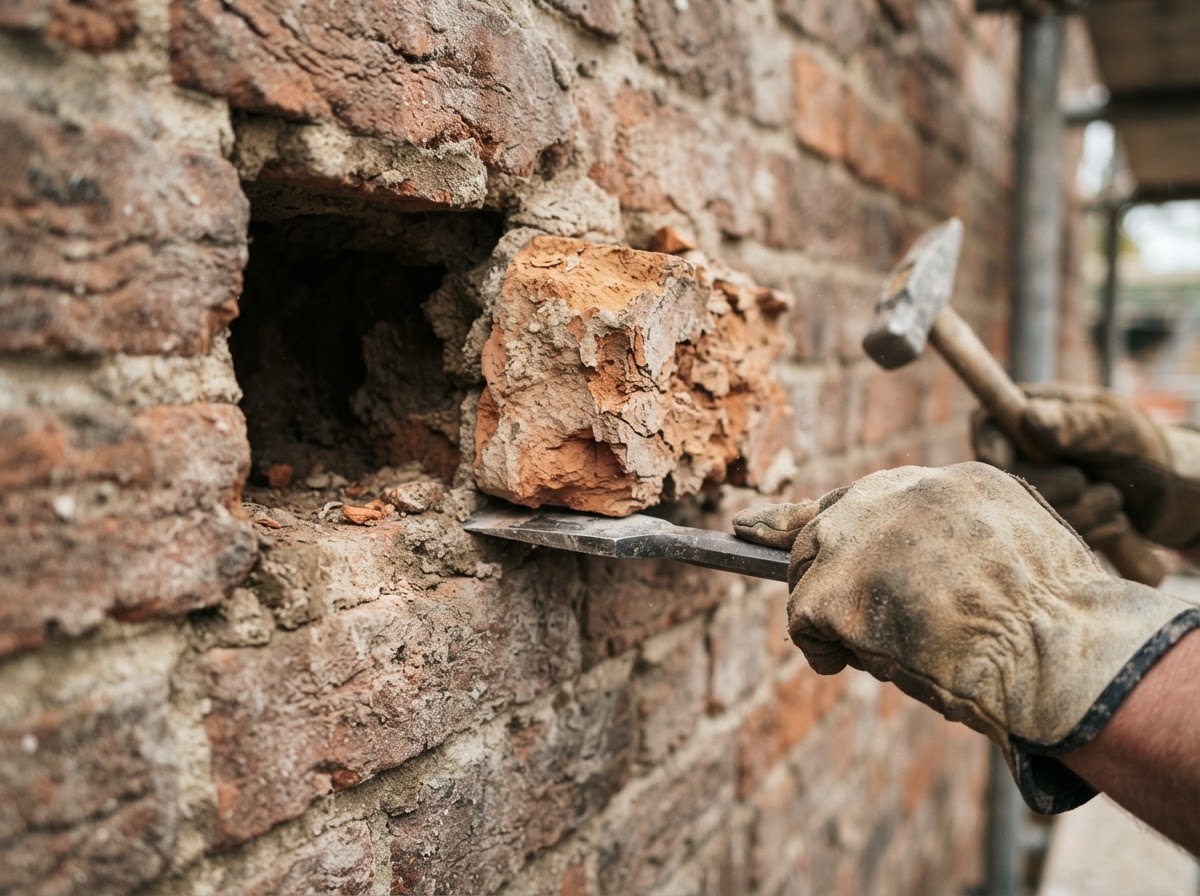
Spalled Brick Replacement
Spalled brick replacement addresses clay brick faces that have flaked, popped, or deteriorated from moisture absorption and freeze-thaw cycling on Ames residential and commercial exteriors. It suits walls where individual units have lost their surface integrity but the surrounding masonry remains sound.
The spalled units are carefully removed without disturbing adjacent brick, replacement units are selected to match the existing brick in size, color, and texture, and the new brick is set in compatible mortar matched to the existing joints with proper joint tooling and bond pattern continuity.
Owners get a weathertight wall with the deteriorated brick replaced and the surface integrity restored, preventing the water entry that spalled units allow and the progressive deterioration that follows.
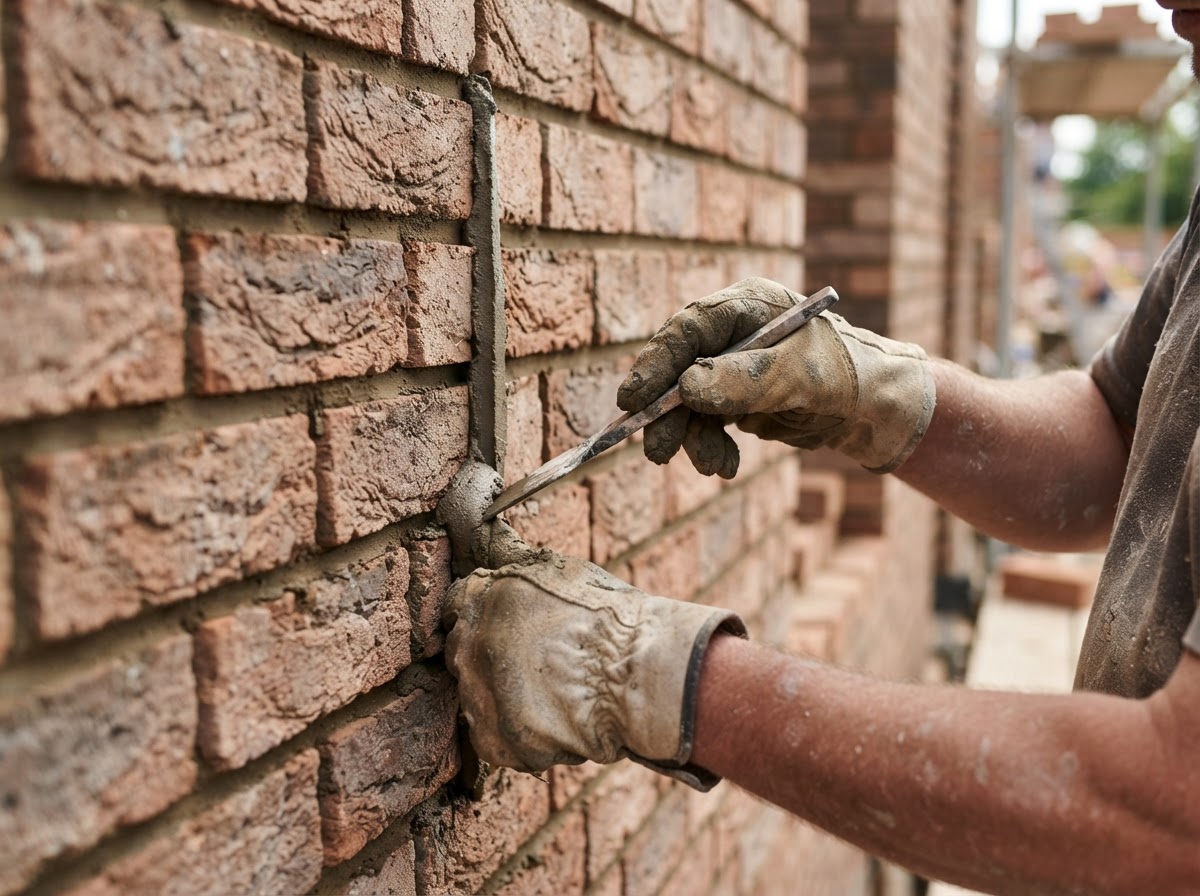
Cracked or Broken Brick Repair
Cracked or broken brick repair addresses individual units that have cracked from impact, stress, or isolated damage on Ames masonry walls. It suits situations where the brick itself is damaged but the cracking is not part of a broader movement pattern.
The cracked units are evaluated to distinguish isolated damage from movement-related cracking, and the damaged brick is replaced with compatible units set in matched mortar. If the cracking indicates movement, the cause is evaluated before repair so the new brick does not crack again.
Owners get damaged brick replaced with sound units that blend with the wall, with the confidence that movement-related cracking has been distinguished from isolated damage and addressed appropriately.
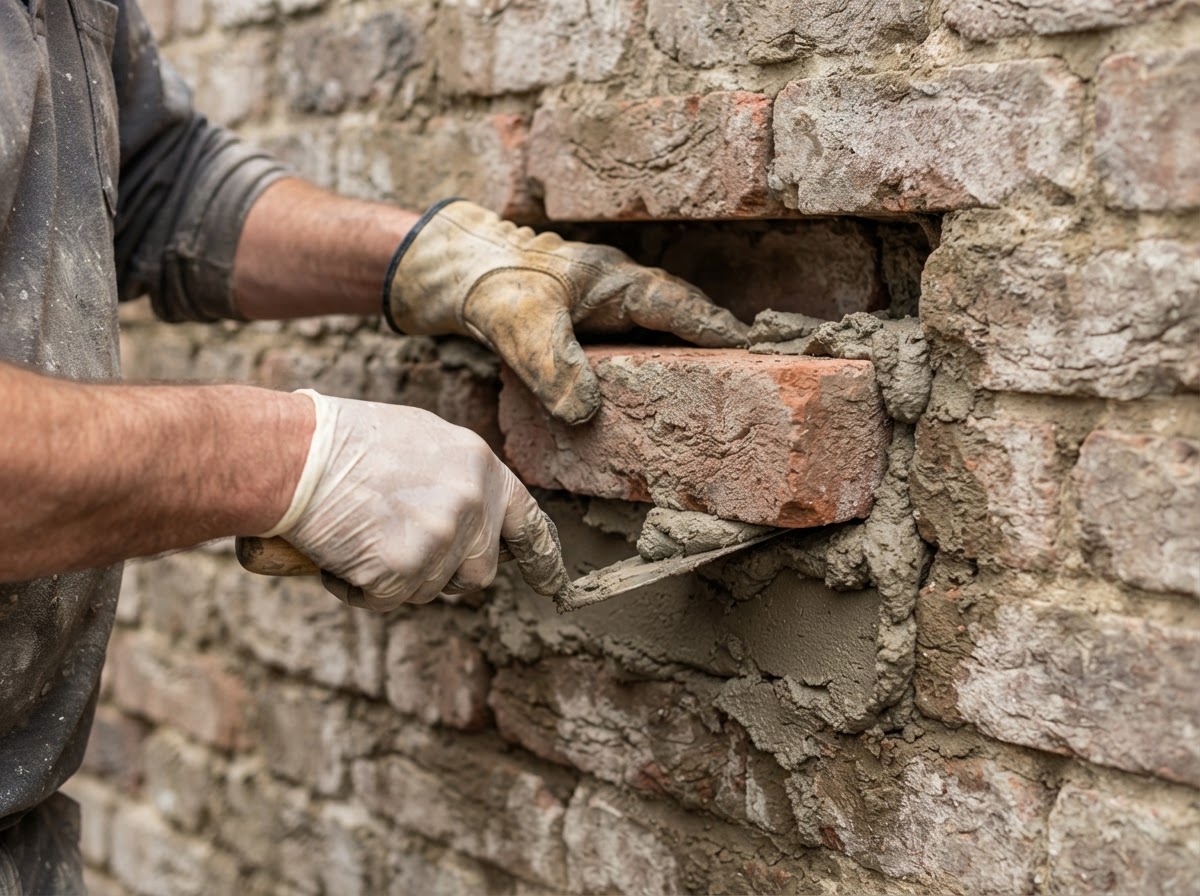
Loose or Displaced Brick Repair
Loose or displaced brick repair stabilizes units that have shifted, rotated, or pulled out of plane on Ames walls, often from failed mortar or movement. It suits walls where individual bricks or small sections have loosened but the wall is otherwise structurally sound.
The loose units are removed, the cavity is cleaned, and the brick is reset or the affected section selectively rebuilt with compatible mortar and proper bearing, with the movement or support condition that caused the displacement evaluated so the reset stays secure.
Owners regain a plumb, stable wall with brick firmly set in sound mortar, eliminating the safety and water-entry hazards that loose or displaced units create.
Mortar Joint Repair Around Damaged Brick
Mortar joint repair around damaged brick corrects the failed joints that often accompany brick damage on Ames walls. It suits situations where brick has failed and the surrounding mortar joints have also deteriorated, which is common because the same moisture and movement affect both.
Failed mortar joints around the damaged units are repointed with compatible mortar matched to the existing joints, rather than replacing brick alone and leaving failed joints in place. The joint profile and tooling match the surrounding masonry so the repair blends and sheds water correctly.
Owners get a repair where both the brick and the joints are sound, protecting the wall from the water entry that failed joints allow and ensuring the repair integrates with the surrounding masonry.
What Causes Brick Damage in Ames?
Freeze-Thaw Moisture Damage
Brick absorbs moisture from rain, snow, and failed mortar joints, and when that moisture freezes and expands, it pops the brick face off — a process called spalling. Central Iowa freeze-thaw cycles make this a primary cause of brick deterioration, especially on walls with poor drainage or water-repellent needs.
Failed Mortar Joints and Water Entry
When mortar joints erode, crack, or recede, they no longer keep water out of the wall, and the moisture that enters saturates the brick and accelerates deterioration. Failed joints and brick damage often go together because the same moisture affects both, which is why joint repair is usually part of brick repair.
Movement Around Openings or Wall Sections
Movement from settlement, thermal expansion, or support issues cracks brick, particularly around openings where lintels and stress concentrations are located. Movement-related cracking follows patterns — stair-step, horizontal, or vertical — that indicate the cause and must be evaluated before repair.
Previous Incompatible Repairs
Prior repairs using mortar that is too hard, the wrong color, or incorrect methods can damage surrounding brick by concentrating stress or trapping moisture. Incompatible repairs often create the mixed conditions that a later, correct repair must resolve, which is why matching matters.
What Are the Signs You Need Brick Repair?
Flaking or Spalling Brick Faces
Brick faces that are flaking, popping, or have pieces missing have spalled from moisture absorption and freeze-thaw damage. Spalling is a sign that water is entering the brick and the units are deteriorating, and the damaged brick should be replaced before the damage spreads.
Loose or Missing Brick
Brick that is loose, shifting, or has fallen out of the wall indicates failed mortar or movement. Loose or missing brick is a safety and water-entry hazard that should be stabilized and replaced promptly, with the cause evaluated before repair.
Stair-Step or Localized Cracking
Cracks that follow mortar joints in a stair-step pattern, or localized cracking in individual brick, indicate movement or stress in the wall. The crack pattern is evaluated to determine whether the cause is settlement, movement, or isolated damage before repair is defined.
Open Mortar Joints Around Damaged Units
Mortar joints that are open, recessed, or missing around damaged brick indicate that the joints have failed alongside the units. Open joints admit water and should be repointed as part of the brick repair, or the new brick will deteriorate from the same moisture.
How Does Brick Repair Work?
Step 1: Assess the Brick, Mortar, and Cause
The damaged brick, surrounding mortar joints, and the wall conditions are evaluated to determine why the units failed — freeze-thaw, water entry, movement, or incompatible prior repairs. This assessment shapes the entire repair scope and ensures the cause is addressed, not just the visible damage.
Step 2: Define Selective Repair vs Broader Restoration
The scope is defined based on the assessment — whether the repair is selective brick replacement, requires repointing of surrounding joints, or indicates a broader restoration need. Selective repair is chosen when the surrounding masonry is sound, preserving sound brick rather than rebuilding unnecessarily.
Step 3: Remove Damaged Material Carefully
Damaged brick is removed carefully without disturbing the surrounding sound units, using appropriate tools with dust control where applicable. Careful removal preserves the bond pattern and the integrity of the adjacent masonry, so the repair blends seamlessly.
Step 4: Install Compatible Brick and Mortar
Replacement brick is selected to match the existing units in size, color, and texture, and is set in compatible mortar matched to the existing joints for composition and color. The new brick is laid in the existing bond pattern with proper joint tooling so the repair integrates with the wall.
Step 5: Tool, Clean, and Review the Repair
Mortar joints are tooled to the correct profile, excess mortar is cleaned from the brick faces, and the finished repair is reviewed for appearance and integrity. The work is left clean, and the cause of the original damage is documented so the owner understands what to monitor going forward.
How Much Does Brick Repair Cost in Ames?
Brick repair pricing depends on the number of damaged units, replacement brick availability, mortar matching, access, and whether the repair is combined with tuckpointing. The locked tuckpointing benchmark applies only to adjacent repointing work, not to brick replacement itself. An estimate gives a number tied to your specific wall.
Brick Repair Pricing Basis
One or a few localized brick replacements: approximately $150–$500+ per area
Depends on replacement brick availability, mortar compatibility, number of units, access and height, and demolition difficulty. A single spalled brick is at the low end; multiple units or elevated access move the price up.
Multiple damaged units or combined tuckpointing: higher project scope
When multiple units are damaged or the repair is combined with repointing of surrounding joints, the scope grows. Adjacent tuckpointing runs about $7.86–$11.24 per square foot as a planning benchmark, separate from the brick replacement cost itself.
Cost Drivers
Replacement brick and mortar matching
Replacement brick availability — especially for older or discontinued brick — and mortar color and composition matching affect cost. Hard-to-source brick or complex matching adds to the price and may affect timeline.
Access, movement, and lintel/flashing conditions
Elevated or access-constrained repairs require scaffolding or lifts. Wall movement, lintel or flashing conditions, and cleanup all move the total. An on-site estimate is needed for exact pricing tied to your wall.
Most localized brick repair does not require a permit, but if the damage is part of a structural wall or lintel issue, permit requirements may apply. Verify project-specific requirements with the City of Ames where relevant.
Get Your Estimate
Tell us about your project. We respond to estimate requests for Ames, Nevada, Huxley, Story City, Iowa.
Frequently Asked Questions About Brick Repair
How much does brick repair cost in Ames?
Brick repair in Ames typically runs from about $150 to $500 or more per area, depending on the number of damaged units, replacement brick availability, mortar matching, access, and whether the repair is combined with tuckpointing. Adjacent repointing runs about $7.86–$11.24 per square foot as a separate benchmark. An on-site estimate is needed for exact pricing.
Can individual damaged bricks be replaced?
Yes, individual damaged bricks can be replaced without rebuilding the whole wall when the surrounding masonry is sound. The damaged unit is carefully removed, a compatible replacement brick is set in matched mortar, and the joints are tooled to blend with the surrounding masonry.
What causes brick faces to spall in Iowa?
Brick faces spall when moisture absorbed into the brick freezes and expands, popping the face off. Central Iowa freeze-thaw cycles make this a common cause of brick deterioration, especially on walls with poor drainage, failed mortar joints, or brick that is more absorptive than others.
Is cracked brick always a structural problem?
No, cracked brick is not always a structural problem. Some cracks are from isolated impact or stress on a single unit, while others indicate movement, settlement, or support issues. The crack pattern and surrounding conditions are evaluated to determine whether the cause is cosmetic or structural before repair is defined.
Can new brick and mortar match older masonry?
New brick and mortar can be closely matched to older masonry in size, color, texture, and joint profile, though an exact invisible match is not always possible because existing brick has aged and weathered. Compatible materials give a visually integrated repair that respects the existing wall within the limits of available matching material.
When does brick repair also require tuckpointing?
Brick repair requires tuckpointing when the mortar joints around the damaged brick have also failed, which is common because the same moisture and movement affect both. Repointing the surrounding joints as part of the repair ensures the new brick is set in sound mortar and the wall is weathertight.
How long does localized brick repair usually take?
Localized brick repair — replacing one or a few units — is typically a short project, often completed in a day or less depending on access and the number of units. Larger repairs or those combined with tuckpointing take longer, and the timeline is confirmed with the estimate.
Request Brick Repair in Ames
Call Ames Masonry Pro at 515-715-4950 for brick repair in Ames, Nevada, Huxley, and Story City. 10+ years of masonry experience and insured service, with cause-first diagnosis and compatible materials.
Masonry Repair • Tuckpointing • Masonry Restoration • Masonry Waterproofing • Stone Repair • FAQs
Request an Estimate
Tell us about your project. We respond to estimate requests for Ames, Nevada, Huxley, Story City, Iowa.