Concrete Driveway Installation in Ames, IA | 10+ Years Experience
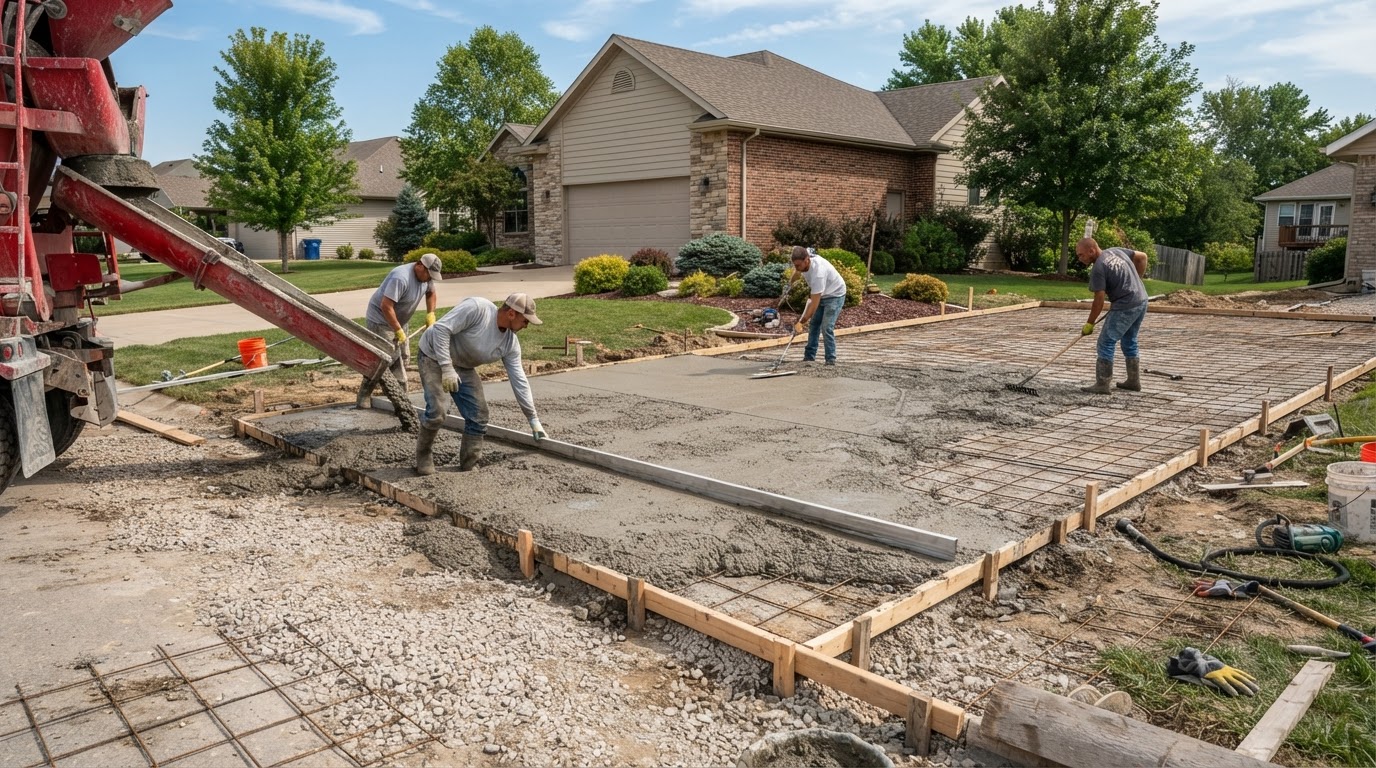
A concrete driveway is the hardest-working flatwork on most Ames properties, taking vehicle weight, winter salt, snow shovel abuse, and freeze-thaw cycling year after year. Ames Masonry Pro installs and replaces concrete driveways with 10+ years of flatwork experience and full insurance, building each one on a prepared subgrade with the base, reinforcement, joints, drainage, and finish the site actually calls for, not a one-size pour.
Concrete that cracks and settles usually does so because of what is underneath it and how it was finished, not the concrete itself. A driveway on soft subgrade, with poor drainage pooling against it, or without the right control joints will show those problems within a few winters. We treat the subgrade, base, layout, drainage, and curing as the real work, with the pour and finish as the visible result. Call 515-715-4950 or send the project address through the form.
Request an Estimate
Tell us about your project. We respond to estimate requests for Ames, Nevada, Huxley, Story City, Iowa.
Why Choose Ames Masonry Pro for Concrete Driveway in Ames?
10+ Years of Masonry Experience
More than a decade of flatwork in Central Iowa has taught us how our subgrade, freeze-thaw cycles, and vehicle loading actually affect a driveway over time, not just on the day it is poured.
Insured for Your Project
We carry insurance, so your property and the work are covered while the pour and finishing are underway.
Subgrade and Base Focus
We prepare the subgrade and aggregate base properly, because a driveway on soft or uneven ground is the one that settles and cracks. The base is the foundation of the slab.
Drainage Planning
Water pooling against or under a driveway undermines the base and heaves the slab in winter, so we plan drainage and grade so water moves away from the slab, not under it.
Joint and Transition Awareness
Control joints, isolation joints, and the transitions to the garage and sidewalk are where driveways crack predictably if they are ignored. We place them where the slab actually wants to move.
Weather-Aware Placement and Curing
Concrete placed and cured in the wrong conditions is vulnerable to scaling and weak surfaces, so we schedule and protect the pour for Central Iowa weather rather than pouring on a bad day and hoping.
Transparent Pricing
You get a clear scope and a real cost-driver breakdown before we start, so the estimate reflects the actual demolition, base, reinforcement, drainage, and access the job needs.
Our Concrete Driveway Services
New Concrete Driveways
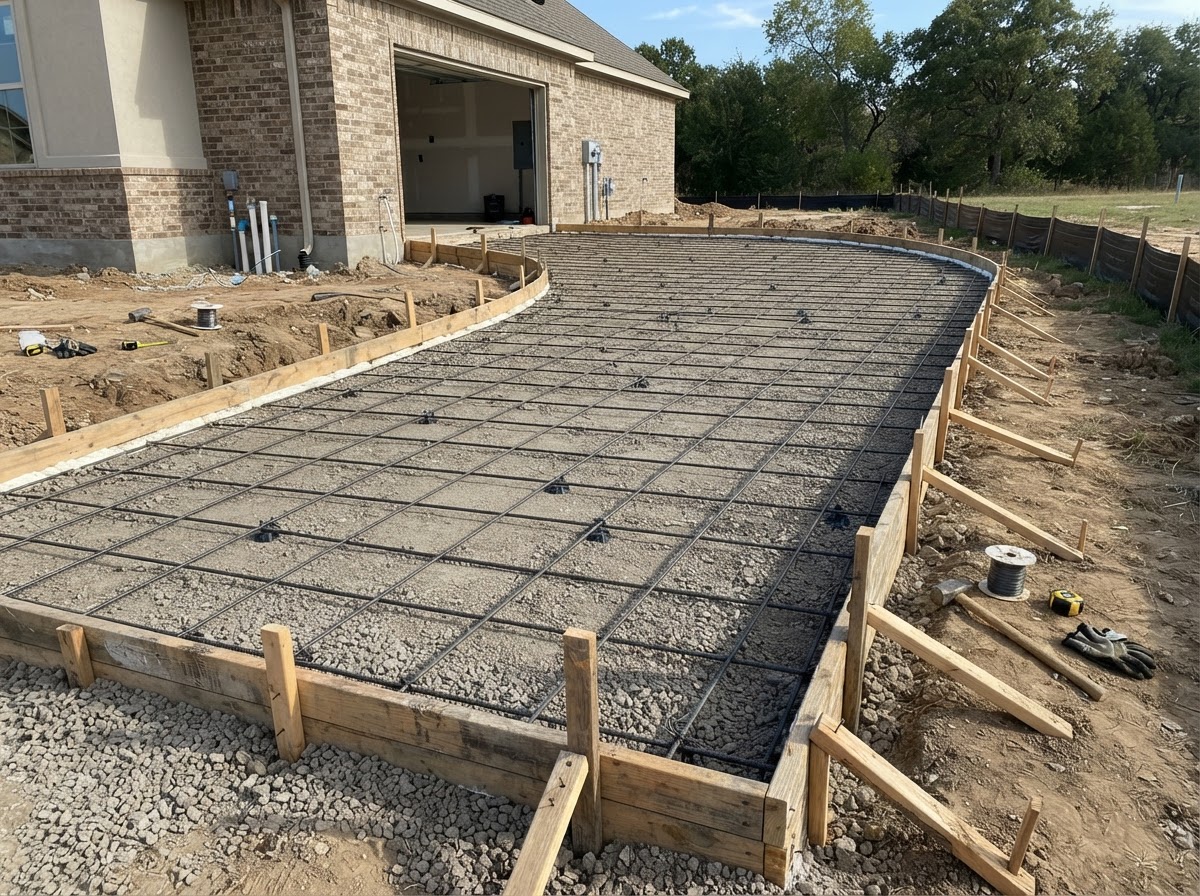
A new concrete driveway starts with a bare site or an area of lawn that is being converted to a durable vehicle surface. The first decisions are the footprint, the approach to the garage or street, and where the water will go.
We excavate to the subgrade, place and compact the aggregate base, set forms to the right elevation and slope, install reinforcement where the project calls for it, and place and finish the concrete with control and isolation joints planned for the slab. The subgrade and base are what keep the slab from settling, so they get the attention.
The finished driveway is a solid, properly sloped surface that carries vehicle weight and sheds water, with joints placed to control where cracking happens instead of leaving it to random chance.
Concrete Driveway Replacement
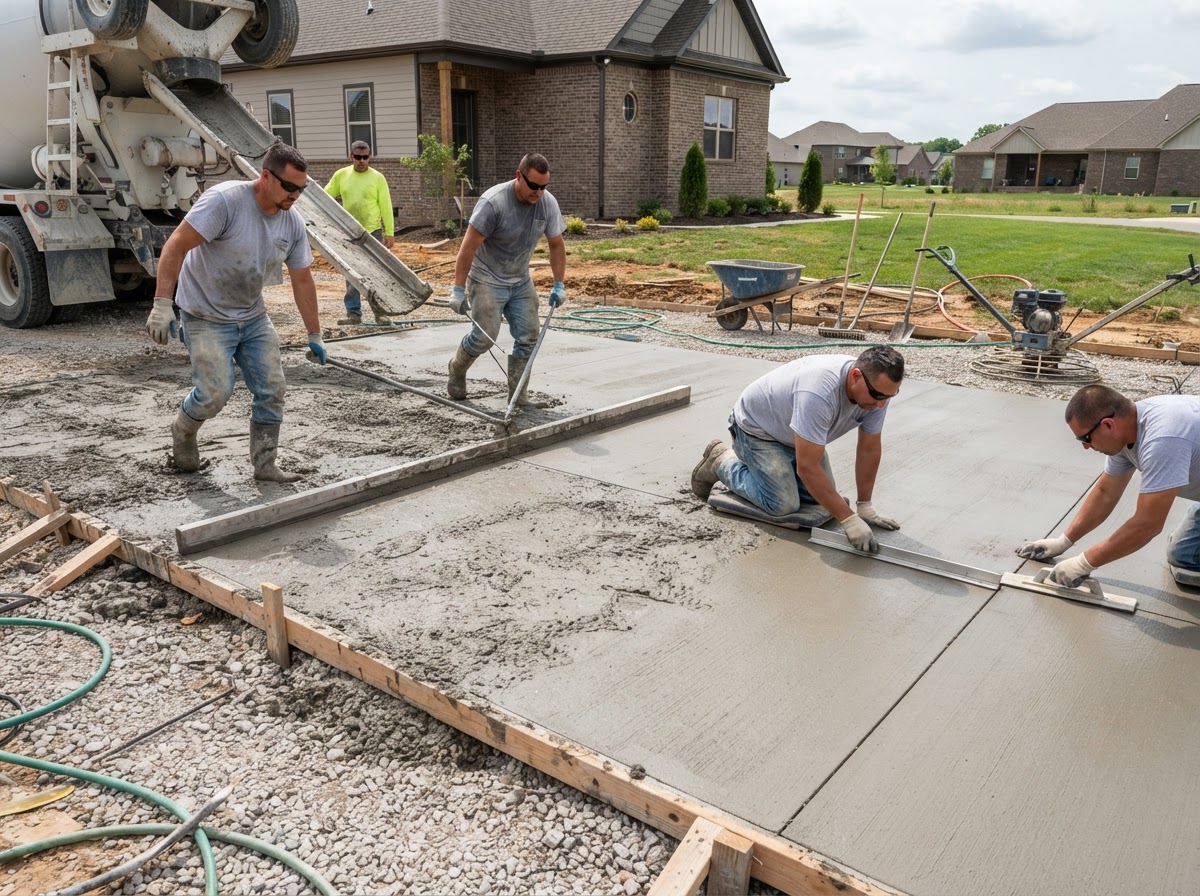
Most driveway work is replacement, removing an old slab that has cracked, scaled, settled, or reached the end of its useful life. The demolition and haul-off are real parts of the job, and so is diagnosing why the old driveway failed.
Out comes the old slab, and then we grade and compact the subgrade, lay the aggregate base, and set forms to the right elevation and slope. We pour the new driveway with control and isolation joints placed for the actual layout, and where the old slab cracked from poor drainage or settled in a low spot, we correct those conditions before the new concrete goes in.
The new driveway sits on a corrected base with drainage addressed, so it does not repeat the cracking and settling that took out the old slab.
Driveway Extensions or Additional Flatwork Where Site Conditions Allow
Some projects add a parking pad, widen a driveway, or extend the slab to a new garage or outbuilding. Extensions have to tie into the existing driveway elevation and match the finish rather than leaving a visible seam or a mismatched slope.
We prepare the new subgrade and base, tie the new slab into the existing elevation and drainage, and match or complement the finish and joint layout so the extension reads as part of the original driveway. Not every existing driveway can be cleanly extended, and we tell you when a replacement makes more sense than an add-on.
The extension carries the same vehicle loading as the rest of the driveway, on a base that keeps it from settling away from the original slab over time.
Driveway Sections and Transitions
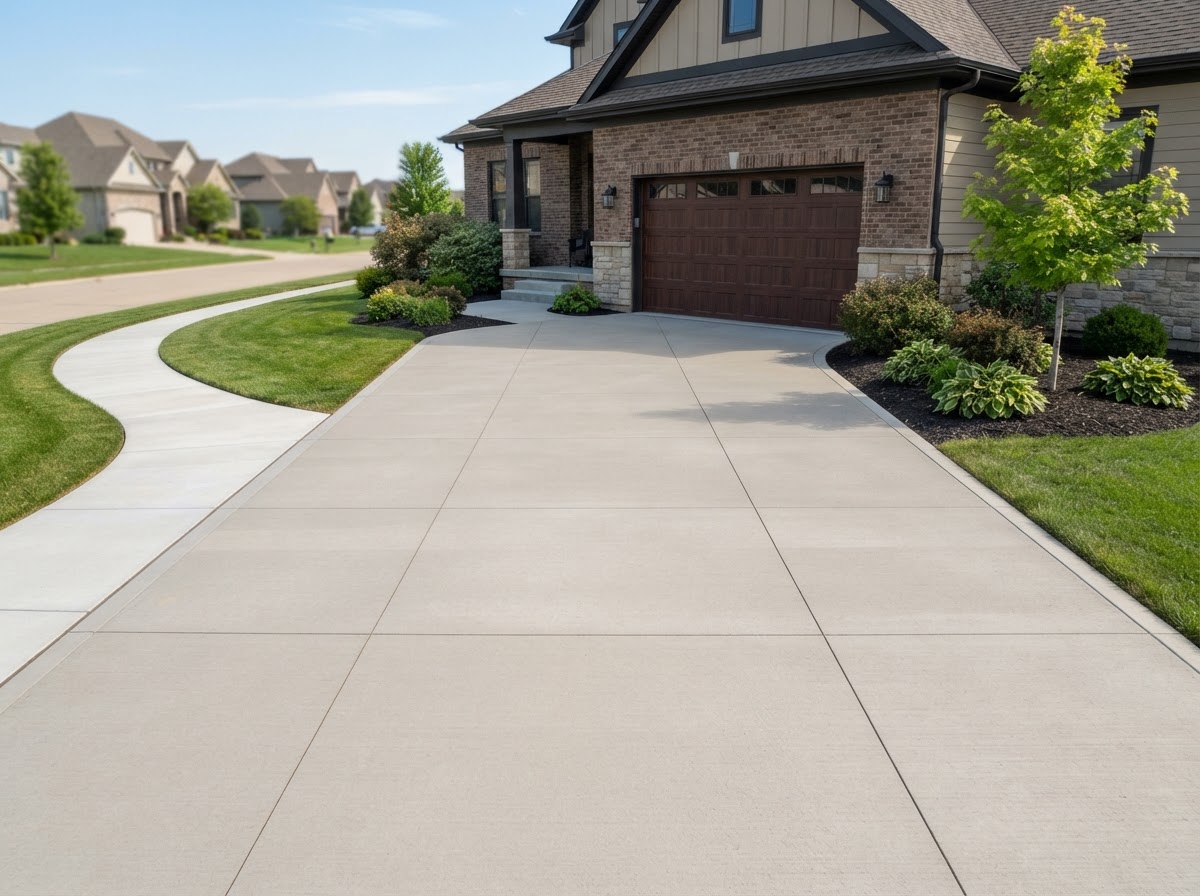
Many driveway projects involve sections, aprons, or transitions to the garage, the sidewalk, or the street. These points are where driveways crack and separate if the joints and elevations are not planned.
We place isolation joints where the driveway meets other concrete or structures, control joints where the slab wants to crack, and plan the elevation transitions so the approach to the garage and the sidewalk crossing are flush and properly sloped. Those details are what keep a driveway from cracking at the garage line or heaving at the apron.
The finished transitions are flush and jointed, so the driveway meets its connections cleanly instead of cracking where it meets the garage or the walk.
What Causes Concrete Driveways to Crack or Deteriorate?
Subgrade or Base Movement
A driveway poured on soft, uncompacted, or uneven subgrade settles where the base is weak, and the slab cracks along those settlement lines. Under vehicle weight that failure shows up within a few winters, which is why the subgrade and base get the attention before the pour.
Freeze-Thaw Exposure and Moisture
Central Iowa's freeze-thaw cycles and the moisture and salt a driveway absorbs scale and crack the surface over years. Concrete that is not properly finished, cured, or jointed is far more vulnerable to freeze-thaw surface damage than concrete that is placed and protected correctly.
Drainage Problems
Water that runs under or pools against a driveway undermines the base and heaves the slab. A driveway that sheds water away from the slab lasts; one that traps it against the edge or the garage does not, and the base failure shows up as cracking and settlement.
Loading, Jointing, or Existing Site Conditions
Heavy vehicle loads, missing or misplaced control joints, and tree roots or adjacent structures can all stress a slab. Without joints where the concrete wants to crack, the slab cracks where it wants to, unpredictably, which is why joint placement is a real part of the pour.
When Should a Concrete Driveway Be Replaced?
Widespread Settlement or Uneven Sections
When large sections of the driveway have settled unevenly, the base has moved, and patching or leveling the surface does not fix the foundation underneath. Replacement with a corrected base is the durable answer.
Extensive Deterioration Across Large Areas
Widespread scaling, spalling, or crumbling across most of the surface means the concrete has deteriorated past point repairs. Spot fixes on a failing slab just delay replacing the whole driveway.
Repeated Drainage or Grade Problems
If the driveway keeps pooling water, heaving in the same spot, or cracking where water runs under it, the drainage and grade need to be corrected, and that usually means replacement rather than another patch.
Repair No Longer Addresses the Overall Surface
When cracks, settlement, and surface damage add up to a driveway that looks and rides like it is failing as a whole, continued spot repairs are costing money without fixing the underlying base and drainage problems.
How Does Concrete Driveway Installation Work?
Step 1: Evaluate Layout, Drainage, Access, and Existing Surface
We confirm the layout against the garage and street, read the grade and where water goes, check access for trucks and equipment, and assess the existing surface if this is a replacement. The scope follows from what we find here.
Step 2: Remove Existing Concrete and Prepare Subgrade/Base as Required
We break out and haul off the old driveway if there is one, excavate to the subgrade, and place and compact the aggregate base to a stable, level surface. Correcting the base is what prevents the new slab from repeating the old failures.
Step 3: Set Forms and Reinforcement Appropriate to the Project
We set forms to the right elevation and slope for drainage, and install reinforcement where the project calls for it. The forms and reinforcement are placed for the actual slab size and loading, not from a default template.
Step 4: Place, Finish, and Joint the Concrete
We place and screed the concrete, work the surface to a texture that grips tires without being rough, and lay in control and isolation joints where the slab is most likely to crack. The joint placement is planned to the driveway's panel layout, not just spaced evenly and hoped for.
Step 5: Cure, Protect, Clean, and Review Before Normal Use
We cure and protect the slab to strength, clean the site, and walk the finished driveway with you to confirm the drainage, the garage approach, and the joint layout before it opens to traffic.
How Much Does a Concrete Driveway Cost in Ames?
Concrete driveway pricing in Ames reflects the demolition, base, reinforcement, drainage, and access the job actually requires, not a single per-foot number that fits every driveway. The locked Ames market research points to roughly $6 to $11 per square foot as a planning reference, and that figure is a planning benchmark, not a fixed bid. A short, straight driveway with easy truck access and no existing slab to remove is a very different project from a long driveway with difficult access, a base that needs correction, and a new garage transition.
Concrete Driveway Planning Reference
Concrete driveway: approximately $6–$11 per sq. ft.
This locked Ames planning benchmark is a reference, not a fixed bid. Demolition, base preparation, reinforcement, drainage, access, size, finish, and transitions all move the final number, so two driveways of similar size can cost differently.
Cost Drivers
Demolition, base, reinforcement, drainage, and access
The real cost drivers are the demolition and haul-off of an existing driveway, the square footage, any excavation and subgrade correction, the aggregate base, reinforcement where the project requires it, access for concrete trucks, the concrete volume and finish, grade and drainage work, transitions and steps or curbs, and any permit or right-of-way considerations where applicable.
Permit and right-of-way requirements depend on the project scope and location, particularly where the driveway meets the street or public sidewalk. Some driveway work falls under City of Ames requirements and some does not, so project-specific requirements should be confirmed with the City of Ames.
Get Your Estimate
Tell us about your project. We respond to estimate requests for Ames, Nevada, Huxley, Story City, Iowa.
Frequently Asked Questions About Concrete Driveway
How much does a concrete driveway cost in Ames?
The locked Ames planning benchmark is roughly $6 to $11 per square foot, but that is a planning reference, not a fixed bid. Demolition, base preparation, reinforcement, drainage, access, size, finish, and transitions all move the final number, so two driveways of similar size can cost differently. We give you a real estimate after seeing the site.
What affects concrete driveway pricing?
The biggest drivers are demolition and haul-off of an existing slab, the square footage, subgrade and base correction, reinforcement, access for concrete trucks, the finish, drainage work, and any transitions or right-of-way considerations. The base and demolition work that makes the driveway last often costs as much as the pour itself.
How long before a new concrete driveway can be used?
A driveway needs real strength before it carries a vehicle, and that depends on the mix, the weather, and how it was cured, so we will not hand you one fixed number. Foot traffic can come sooner than a car, and cold pours take longer. We will tell you the realistic wait for your pour and conditions.
Why are control joints installed?
Control joints give concrete a planned place to crack as it shrinks and shifts with temperature instead of breaking wherever it wants. Driveways are long, wide slabs that want to crack in predictable lines, and tooling or cutting those joints in directs the movement there rather than across the field. A crack at a joint is the joint doing its job, not a flaw.
Can a badly cracked driveway be repaired instead of replaced?
Minor isolated cracks can sometimes be repaired, but widespread cracking, settlement, or base failure usually means the foundation has moved, and patching the surface does not fix that. We tell you honestly when replacement is the durable answer rather than selling a repair that will not hold. A driveway with a failed base needs the base addressed.
How does freeze-thaw weather affect concrete driveways?
Driveways take the worst of it because they sit saturated with meltwater and get hit with salt, and that moisture freezing in the surface lifts flakes off the top over years. Good placement, curing, and jointing give the surface a fighting chance; a thin or poorly finished driveway scales fast. Our winters are what eventually separate a well-built driveway from a careless one.
Does reinforcement prevent all concrete cracks?
Reinforcement helps control cracking and hold the slab together, but no reinforcement eliminates all cracking, because concrete naturally shrinks and moves as it cures and responds to temperature. Control joints and a stable base do more to manage cracking than reinforcement alone. We use reinforcement where the project calls for it, not as a crack-proof guarantee.
Do concrete driveway projects in Ames require permits?
Permit and right-of-way requirements depend on the project scope and location, particularly where the driveway meets the street or public sidewalk. Some driveway work falls under City of Ames requirements and some does not, so project-specific requirements should be confirmed with the City of Ames. We flag that during planning rather than discovering it mid-project.
Request a Concrete Driveway Estimate in Ames
Planning a new driveway, or replacing one that has cracked and settled? Tell us the size, the location, and whether there is an existing slab that needs to come out. We will look at the subgrade and drainage and put together a real estimate based on your actual site. Call 515-715-4950 or send the project address and service request through the form.
Concrete Flatwork • Concrete Patios • Concrete Sidewalks • Concrete Steps • Paver Patios • FAQs
Request an Estimate
Tell us about your project. We respond to estimate requests for Ames, Nevada, Huxley, Story City, Iowa.