Concrete Patio Installation in Ames, IA | 10+ Years Experience
A concrete patio gives you a clean, durable outdoor surface for seating, cooking, and foot traffic without the joints and maintenance of pavers. Ames Masonry Pro installs and replaces concrete patios across Ames and nearby communities with 10+ years of flatwork experience and full insurance, building each one on a prepared subgrade with the base, drainage, joints, and finish the site actually calls for.
A patio is lighter-duty than a driveway, but it still lives or dies by what is underneath it. A patio poured on soft subgrade, pitched toward the house, or finished without control joints will crack and settle within a few seasons. We treat the grade, base, drainage, and joint layout as the real work, because that is what keeps a patio usable. Call 515-715-4950 or send the project address through the form.
Request an Estimate
Tell us about your project. We respond to estimate requests for Ames, Nevada, Huxley, Story City, Iowa.
Why Choose Ames Masonry Pro for Concrete Patio in Ames?
10+ Years of Masonry Experience
More than a decade of flatwork in Central Iowa means we know how our soils, freeze-thaw cycles, and drainage affect a patio over time, not just on the day it is poured.
Insured for Your Project
We carry insurance, so the property and the work are covered while we are on site.
Site and Drainage Evaluation
A patio that traps water against the house is a problem we design out from the start. We read the grade and pitch the slab away from the structure before any concrete goes in.
Base Preparation
We prepare the subgrade and aggregate base properly, because a patio on soft or uneven ground is the one that settles and cracks. The base is the foundation of the slab.
Transition and Joint Planning
Control joints, isolation joints, and the transitions to doors, steps, and walkways are where patios crack and trip people if they are ignored. We plan them for the actual slab.
Finish Options Within Scope
A broom finish, a smoother surface, or a simple texture each suit different uses, and we place the finish the patio is actually meant for rather than defaulting to one look.
Transparent Estimate and Clear Process
You get a clear scope and a real cost-driver breakdown before we start, so the estimate reflects the actual base, drainage, and finish the job needs.
Our Concrete Patio Services
New Concrete Patio Installation
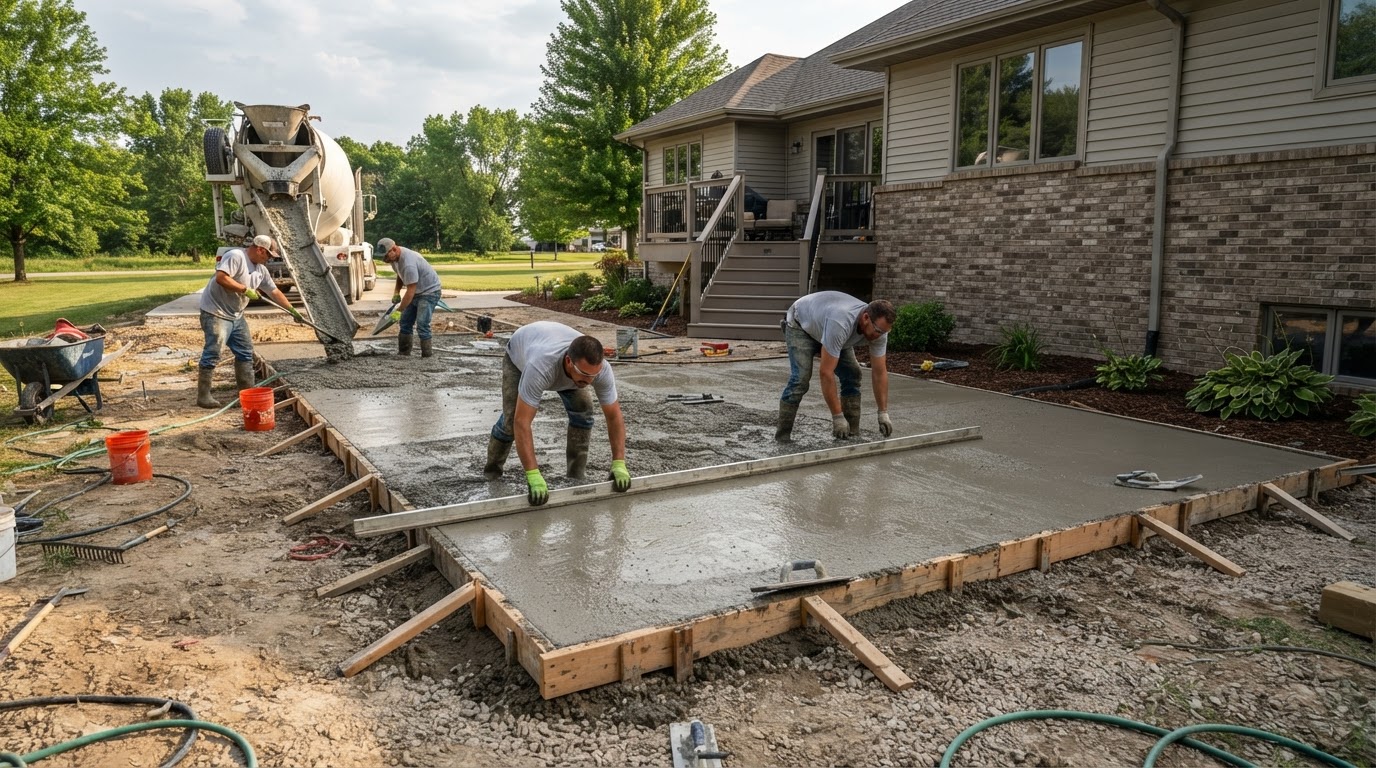
A new concrete patio starts with a blank area of yard, usually grassed or sloped, that we convert into a level outdoor surface sized for how you want to use it. The first conversation is about footprint and use, because a seating area and a cooking area have different needs.
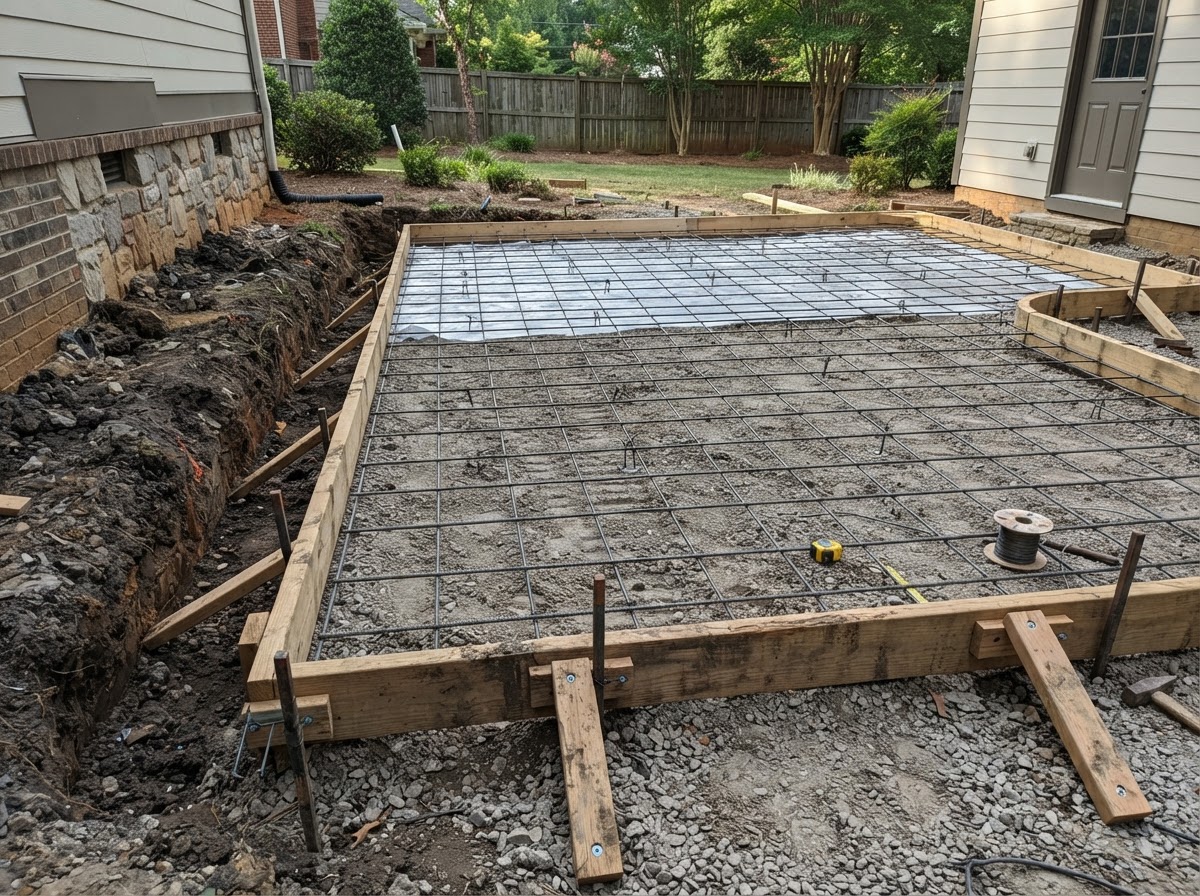
We excavate to the subgrade, place and compact the aggregate base, set forms to the right elevation and drainage slope, install reinforcement where the project calls for it, and place and finish the concrete with control joints planned for the slab. The grade is pitched away from the house so water does not sit against the foundation.
The finished patio is a solid, properly drained surface that holds furniture and foot traffic without settling, with joints placed to control where cracking happens rather than leaving it to chance.
Concrete Patio Replacement
Most patio work is replacement, removing an old slab that has cracked, settled, or scaled and starting over. The demolition and haul-off are real parts of the job, and so is diagnosing why the old patio failed.
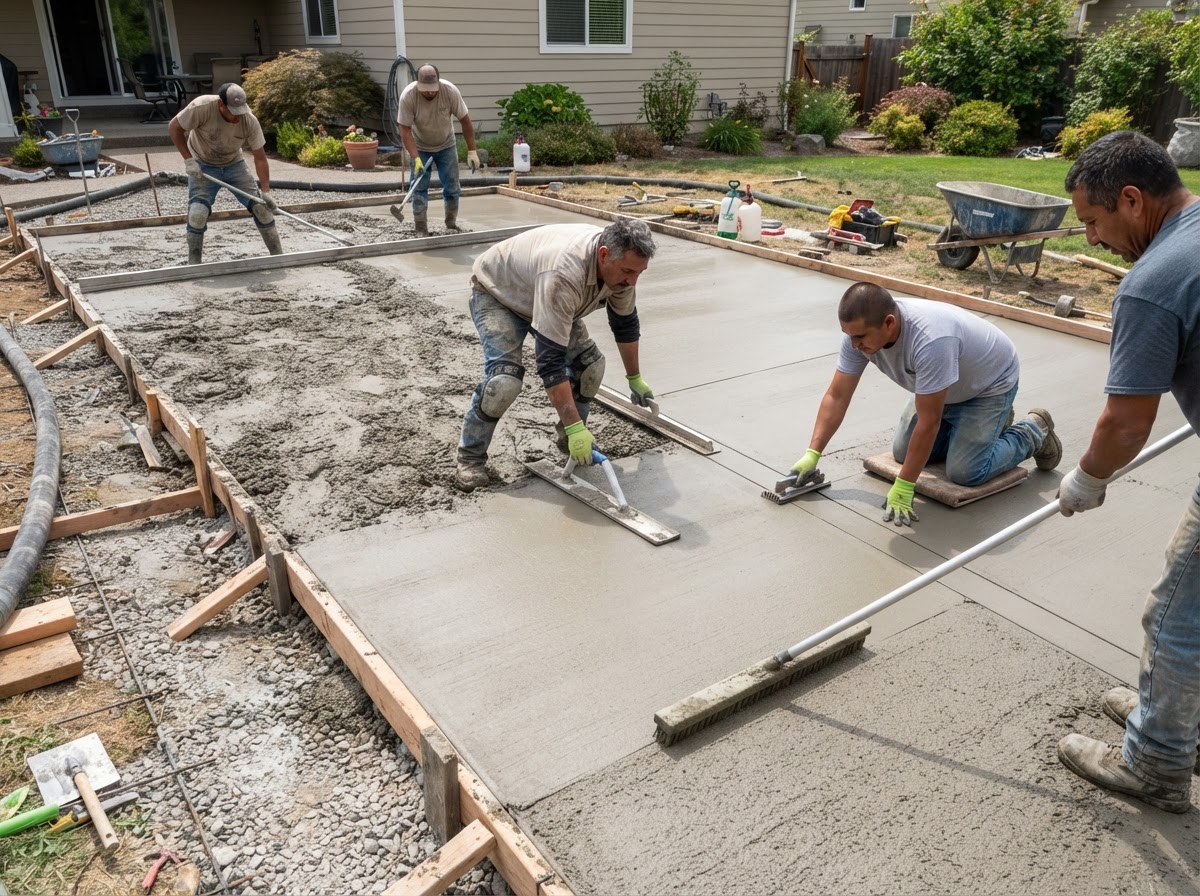
We break out and haul off the existing concrete, evaluate and correct the subgrade and base, set forms for the new slab elevation and drainage, and pour the replacement with the joints and finish the project needs. If the old patio cracked from poor drainage or settled in a low spot, we fix those conditions during the rebuild.
The new patio sits on a corrected base with drainage addressed, so it does not repeat the cracking and settling that took out the old slab.
Patio Extensions Where Site Conditions Allow
Some projects add onto an existing patio, extending it into the yard or tying it into a new step or walkway. Extensions have to match the existing surface elevation and finish rather than leaving a visible seam or a trip lip at the transition.
We prepare the new subgrade and base, tie the new slab into the existing elevation and drainage, and match or complement the finish and joint layout so the extension reads as part of the original patio. Not every existing patio can be cleanly extended, and we tell you when a full replacement makes more sense than an add-on.
The extension carries the same foot traffic as the rest of the patio, on a base that keeps it from settling away from the original slab over time.
Concrete Patio Transitions to Steps, Walkways, or Doors
Where a patio meets a door threshold, a step, or a walkway, the elevation and joint details have to work together. Those transitions are where patios crack and trip people if they are not planned.
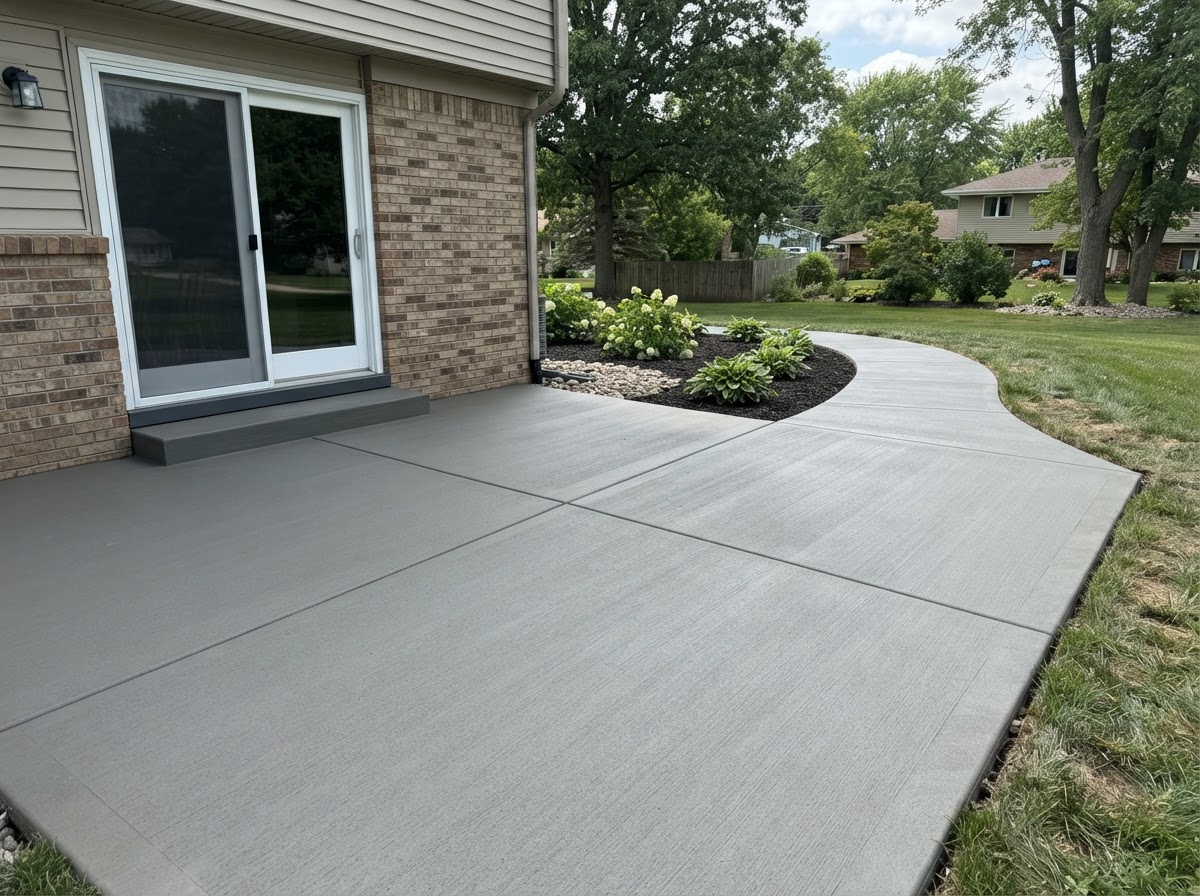
We place isolation joints where the patio meets other concrete or structures, control joints where the slab wants to crack, and plan the elevation transitions so the approach to the door and the walkway connection are flush and properly sloped. Drainage away from the house is built into the grade.
The finished transitions are flush and jointed, so the patio meets its connections cleanly instead of cracking at the threshold or heaving where it meets the walk.
What Causes Concrete Patios to Crack or Settle?
Subgrade or Base Movement
A patio poured on soft, uncompacted, or uneven subgrade settles unevenly, and the slab cracks where it settles. The base is the foundation of the patio, and if it moves, the concrete moves with it. This is the most common cause of patio cracking.
Freeze-Thaw Exposure
Central Iowa's freeze-thaw cycles and the moisture a patio absorbs scale and crack the surface over years. Concrete that is not properly finished, cured, or jointed is far more vulnerable to freeze-thaw surface damage than concrete that is placed and protected correctly.
Drainage and Water Problems
Water that runs under or pools against a patio undermines the base and heaves the slab. A patio that sheds water away from the house and off the surface lasts; one that traps it against the foundation does not, and the base failure shows up as cracking and settlement.
Existing Grade or Adjacent-Structure Conditions
A patio pitched toward the house, built over a utility trench that was not compacted, or placed against a foundation without an isolation joint will crack and settle at those weak points. The site conditions set up the failure before the concrete is even poured.
What Should You Consider Before Installing a Concrete Patio?
Patio Size and Intended Use
How you plan to use the patio drives the footprint. A seating area needs less room than a cooking and dining layout, and the size sets the concrete volume and form work. We start there.
Grade and Drainage
The existing slope and where water goes determine the excavation and drainage work. A patio that traps water against the house is a problem we design out from the start by pitching the slab away from the structure.
Finish and Joint Layout
The surface finish sets the look and slip resistance, and the control joints tell the concrete where to crack as it cures. We plan the joint layout for the actual slab dimensions rather than spacing them blindly.
Door, Step, Walkway, and Landscape Transitions
Where the patio meets a door, a step, a walkway, or the lawn, the elevation and edge details have to work together. Transitions are where sloppy installations trip people and crack slabs, so we plan them.
How Does Concrete Patio Installation Work?
Step 1: Evaluate Layout and Drainage
We confirm the layout against the house and yard, read the grade and where water goes, and check how equipment and concrete reach the area. The drainage plan comes from what we find here, not from a template.
Step 2: Prepare Subgrade/Base and Forms
We excavate to the subgrade, place and compact the aggregate base, and set forms to the right elevation and drainage slope. Correcting the base is what prevents the new slab from repeating old failures.
Step 3: Install Reinforcement Where Appropriate
We install reinforcement where the project calls for it, placed for the actual slab size and use rather than from a default template. Reinforcement helps control cracking but does not eliminate it.
Step 4: Place, Finish, and Joint the Concrete
We place and screed the concrete, finish the surface with a texture suited to the use, and place control and isolation joints where the slab will want to crack. The joints control cracking instead of leaving it to random breaks.
Step 5: Cure, Protect, and Review the Patio
We cure and protect the slab so it reaches proper strength, clean the site, and walk the finished patio with you to confirm the layout, drainage, and transitions before it is opened to use.
How Much Does a Concrete Patio Cost in Ames?
Concrete patio pricing is built from the project, not a single per-foot number, because a small seating patio with easy access is a very different job from a large patio with steps, a door transition, and difficult access. We do not apply the driveway planning benchmark to patios, because patio loading, finish, and layout differ from driveway work. The base, drainage, and transition work that keeps a patio usable often costs as much as the pour itself, which is why two patios of similar size can have very different totals.
Pricing Basis
Estimated by project scope, not a flat per-foot rate
Square footage, demolition, excavation, base correction, access, reinforcement, concrete volume, finish, edges and forms, steps and transitions, drainage, and site grade all shape the total. The driveway $6–$11/sq. ft. benchmark is driveway-specific context and does not automatically apply to patio pricing.
Cost Drivers
Base, drainage, and transitions move the price
A small, accessible patio with a simple finish and a large patio with steps, a door transition, and tight access are priced very differently. For an honest number, send the project address and roughly what you have in mind through the form, and we can put together a real estimate based on your yard.
Concrete patio projects generally do not trigger a building permit, but project-specific requirements, particularly for large patios or work near a property line or public right-of-way, should be confirmed with the City of Ames.
Get Your Estimate
Tell us about your project. We respond to estimate requests for Ames, Nevada, Huxley, Story City, Iowa.
Frequently Asked Questions About Concrete Patio
How much does a concrete patio cost in Ames?
A concrete patio is priced by the project, because size, demolition, excavation, base work, access, reinforcement, finish, transitions, and drainage all shape the total. We do not apply the driveway per-foot benchmark to patios, since patio loading and layout differ. After seeing the site we can give you a real estimate rather than a generic guess.
What affects concrete patio pricing?
The biggest drivers are the square footage, any demolition of an existing slab, excavation and base correction, access for equipment, reinforcement, the concrete volume and finish, steps and transitions, and drainage work. The base and drainage work that keeps the patio usable often costs as much as the pour itself.
How is a concrete patio different from a paver patio?
A concrete patio is a single poured slab with control joints, while a paver patio is individual units laid on a bedding layer with polymeric sand joints. Concrete gives a clean, continuous surface; pavers offer patterns and easier unit-level repair. The right choice depends on the look and maintenance you want, and we can help you weigh both.
Why are control joints used in patios?
Control joints tell the concrete where to crack as it shrinks and moves, instead of letting it crack randomly across the surface. Every concrete slab cracks as it cures and responds to temperature, and joints keep that cracking planned and controlled. It is planned cracking, not a sign of a problem.
How does drainage affect a concrete patio?
Water that sits under or against a patio undermines the base and heaves the slab, so we pitch the surface away from the house and off the patio. A patio that sheds water lasts; one that traps it against the foundation heaves with the first hard freeze. Drainage is planned before the pour, not added after.
Can an old patio be removed and replaced?
Replacing a cracked or settled patio is common, provided we correct the base and drainage that caused the old slab to fail. Pouring new concrete on the same failed base recreates the same problem. The replacement gets a corrected foundation so it does not fail the same way.
How long does a new concrete patio need to cure before normal use?
Concrete needs to reach adequate strength before furniture and foot traffic, and that timing depends on the mix, the weather, and the curing conditions, so we do not promise one universal timeline. We will tell you the realistic wait for your specific pour and weather. Rushing it risks surface damage.
How does Iowa winter weather affect concrete patios?
Freeze-thaw cycles and the moisture a patio absorbs scale and crack the surface over time, especially if the concrete was poorly finished or cured. Properly placed, cured, and jointed concrete resists that damage far better than a slab left to fend for itself. Central Iowa winters are the real long-term test of the work.
Request a Concrete Patio Estimate in Ames
Planning a new patio, or replacing one that has cracked and settled? Tell us the size, the location, and whether there is an existing slab that needs to come out. We will look at the grade and drainage and put together a real estimate based on your actual site. Call 515-715-4950 or send the project address and service request through the form.
Concrete Flatwork • Concrete Driveways • Concrete Sidewalks • Concrete Steps • Paver Patios • FAQs
Request an Estimate
Tell us about your project. We respond to estimate requests for Ames, Nevada, Huxley, Story City, Iowa.